

Robotics doesn't have to start with months of integration work. Viam is the fastest way to go from idea to working robot — and with Viam 101, our upcoming free self-paced course launching this July, you can dive into robotics without buying a single part.
Plus, RSVP by July 31 for the chance to win a $3,500 UFACTORY Lite 6 robotic arm.
Robotics has a reputation for a high price of admission: a lab full of hardware, a degree in mechanical or electrical engineering, and a high tolerance for drivers that cooperate only on a good day. But the thing that actually made robotics slow was never the robot. It was everything around it: the device drivers, the networking, the data plumbing, and the deployment machinery you had to build before you could write a single line of behavior.
What if you didn't have to build all of that yourself? Viam is the fastest way to build a robot because it comes with the infrastructure already in place. Write software against clean APIs and let the platform handle the infrastructure. If you can write Python (or Go, or any other language you prefer), you can build a robot on Viam, and you can start today.
Why robotics was slow, and what changed
Without a platform, building a robot means solving infrastructure problems before you get to the interesting part. Every sensor and motor speaks its own language, so you lose weeks to integration. You write device drivers. You configure networking just to reach the machine at all. You build data pipelines, stand up ML training and deployment, and figure out how to push software to a device sitting on a bench across the room or a fleet across the country.
Viam handles all that infrastructure for you. You declare the hardware and services you need in a JSON config, and Viam installs the hardware drivers you need. Vision, motion planning, and data capture are built in, each exposed through a well-defined API. You write your control logic in the language you already use, and call those APIs through a Viam SDK. With the infrastructure already in place, you can focus on application logic instead of integration work.
What makes Viam the fastest way to build
A few things make development fast:
- Consistent APIs across hardware. Every camera exposes the same interface, regardless of manufacturer. Same for motors, sensors, and arms. Swap an Intel RealSense for an Orbbec Astra, or one motor controller for another, and your application code doesn't change.
- Develop from anywhere. Your code connects to your machine over the network, through firewalls and NAT, no VPN, no port forwarding. Write and test from your laptop, iterate in your IDE, and run against your robot without a copy-and-deploy step.
- Prototype once, deploy many. The configuration that makes one machine work becomes reusable, so you can apply it to one, a dozen, or hundreds of machines. The code you write to prototype is the code that runs in production.
With Viam, the same code carries from your first experiment all the way to a deployed fleet on real hardware, with versioning, OTA updates, and remote monitoring built in.
Start without hardware: Viam 101
The fastest way to learn robotics is to build something end to end and watch it work. That's why we built Viam 101.
Coming July 2026, Viam 101 is a free, self-paced online course where you build a real robotics application on Viam, entirely in simulation, with no hardware required. In about 90 minutes of video alongside hands-on exercises, you'll learn Viam fundamentals, write working control logic,
and come away with the skills to build your own robot.
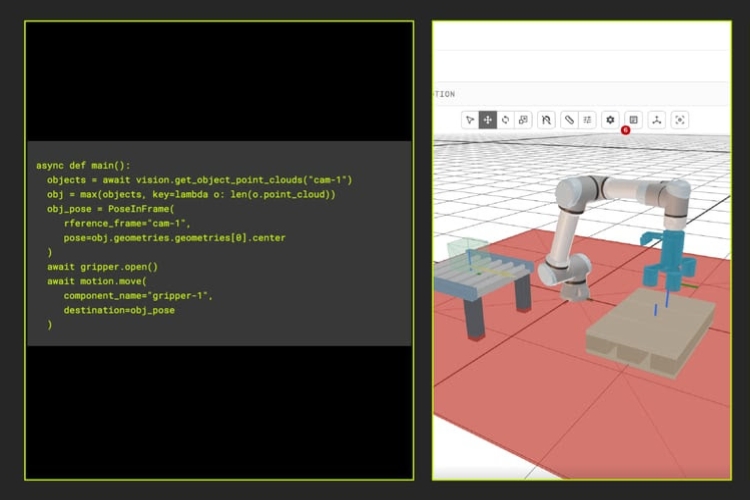
The project at the center of the course is a robot arm that picks up boxes and places them on a pallet, a classic “pick and place” example. You'll write the control logic, run it in simulation, and watch it work.
You'll write genuine Viam application code against the same APIs you'd use on a physical robot, so you’ll learn the real platform without buying a single part.
And, learning in simulation also removes the slowest part of the loop: wiring, mounting, and physical debugging. You’ll spend your time on the logic that drives real behavior..
The course is built for engineers who are comfortable with code. Whether you're new to robotics or an experienced roboticist learning Viam, you'll get up and running quickly.
Where to go from here
Once you've built your first application in simulation, moving to real hardware is straightforward, because it's the same code. There's no rewrite and no separate production version to learn. The prototype you build in the course becomes the foundation for scaling from one machine to a fleet, all on the same Viam platform.
Viam 101 launches July 2026, and RSVPs are open now. Register today to get access the moment it goes live, plus an entry to win a UFACTORY Lite 6 robotic arm valued at $3,500 — so one lucky winner can put their new skills to work on real hardware.
Viam is the fastest way to turn an idea into a working robotics application, from your first prototype to a fleet in production. If you can write software, you can build robots.