Fleet managers know that their operators need simple, focused tools to effectively monitor status and track performance—whether they're working with warehouse robots, food delivery rovers, or any other robotics systems. When implemented well, fleet operators have better visibility over operations, which leads to greater efficiency for their teams and higher productivity for the business.
Traditionally, building custom web interfaces means hiring developers, managing servers, and maintaining web infrastructure, including hosting and authentication, which takes months to develop and effort over time to maintain. The cost to implement these dashboards may even outweigh the benefits.
Viam Apps changes this equation by enabling any organization to rapidly deploy custom web apps for their machines—from single-robot monitoring to complex fleet coordination. Fleet management dashboards represent one powerful application of this feature.
A fictional example helps demonstrate the value: John is a warehouse robotics supervisor at PackFlow Logistics, a growing fulfillment company. His team manages 40+ robot arms across three distribution centers. With Viam Apps handling the hosting, authentication, and infrastructure, John and his IT team can build a custom fleet management dashboard in days instead of months and focus on what matters: giving their operators the custom tools they need to run an efficient warehouse floor.
Transform complex fleet management into a simple, customizable dashboard
John’s operators need an accessible way to observe picking rates, adjust gripper force when switching between fragile and heavy items, and pause entire zones with one click during shift changes. The dashboard needs to show relevant live data and be able to directly control the robots. With Viam, John’s team can integrate their robot systems, set up automation, and stream live operational data from robots to the cloud. Everything is customizable, giving them ultimate control over the metrics and data they track.
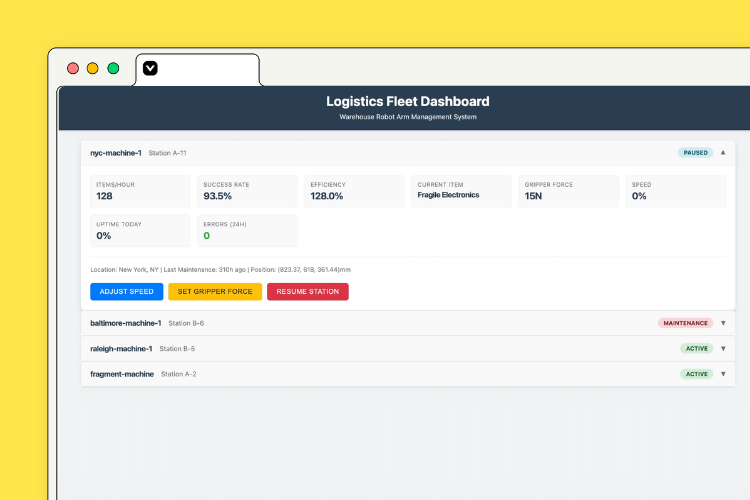
John configures one robot arm and its supporting components, such as cameras, grippers, and sensors in Viam, then reuses that configuration to easily set up the rest of the fleet. Then, using Viam's local web development tools and the TypeScript SDK, he builds a simple dashboard that automatically discovers all robot arms accessible by the operator and displays real-time metrics from every arm.
A sample fleet dashboard created using Viam Apps, complete with live fleet health metrics for all machines in the operator’s assigned fleet and simple actuation commands.
This is all made possible through Viam Apps’ multi-machine support: operators log in once and immediately see every relevant robot type that they have access to. And if warehousing needs change, they can use the SDK to update these metrics and controls to best support operations.
Adding remote gripper force adjustment takes just one additional day of development thanks to the SDK. Now, when switching from one order to the next, operators can update the gripper force settings for an entire zone from their device. John also adds emergency pause buttons that could stop all robots in a section instantly—critical for shift changes and safety protocols.
No-stress deployment
Once John is ready to deploy, it only takes a few commands to get the custom dashboard live at a dedicated Viam-hosted URL. The application is production-ready, secured with HTTPS and built-in login flow, and is accessible from any computer or tablet on the factory floor. Because Viam handles the infrastructure automatically, John can iterate quickly based on operator feedback. When Zone A operators request a new metric for tracking fragile item handling, John adds it in an afternoon and redeploys instantly to the same URL.
Authorization is built-in through Viam's existing permission system. When fleet operators log in, they automatically see only the robots in their assigned zones, while John and his team have the ability to manage everyone’s permissions. John doesn’t write a single line of authorization code or manage any complex user databases—he simply uses the permissions he already configured in Viam.
With Viam Apps, the ongoing maintenance drops to basically zero. John can focus on what his operators need: better visibility, simpler controls, and faster response to changing warehouse demands. The infrastructure is invisible—exactly as it should be.
Using Viam Apps vs. a self-hosted solution
Scaling without the complex infrastructure
The multi-machine support in Viam Apps proves especially valuable as PackFlow expands to new facilities. When they open a fourth distribution center, adding those robots to the dashboard takes minutes. New operators at that facility log in on day one with the same simple interface their colleagues used at other sites. They get instant access to their assigned robots through the same familiar dashboard.
Other teams at PackFlow take notice of John’s team's success. The maintenance department builds their own Viam App for predictive maintenance, aggregating sensor data from all robots to identify units needing service before they fail. The operations team creates a customer-facing dashboard showing real-time fulfillment status across all facilities. No matter the application, Viam Apps helps reduce the time to deployment and brings value more quickly to operators.
Whether you're managing a single machine or hundreds, it’s clear that custom web interfaces are essential to increasing productivity. Instead of spending months building and maintaining web infrastructure, Viam allows you to focus on creating the features your team actually needs. Viam Apps can handle hosting, authentication, and multi-machine coordination automatically, so you can skip the infrastructure complexity entirely. Focus your energy where it creates value: building the exact tools that help your operators excel at their jobs.
What will you build for your fleet? Get started now with our tutorial.
Find us at our next event
Error! No upcoming events found. Please check back later!