

At the beginning of the year, we hit pause on our usual sprint cycles for the Viam Winter 2026 Hackathon. The prompt was simple: build a real-world robotics application from scratch in three days using the same platform we develop every day.
The goal wasn't just to see what we could build. It was to see where we’d break. As Avery Rosen, Technical Chief of Staff, put it during the kickoff: “The emphasis here is on exploration—really getting your hands dirty with the platform that you yourself make.”
Here’s a look at what happens when 50+ engineers shift from building the platform to building on it.
The builds: Salad-makers, rod hockey, and inventory trackers
We didn't want polished demos; we wanted functional hardware. The teams gravitated toward solving the "physical" problems that usually make robotics projects stall: motion planning, machine learning integration, and sensor orchestration. Here’s a sample of the projects we set out to build:
The robotic salad maker
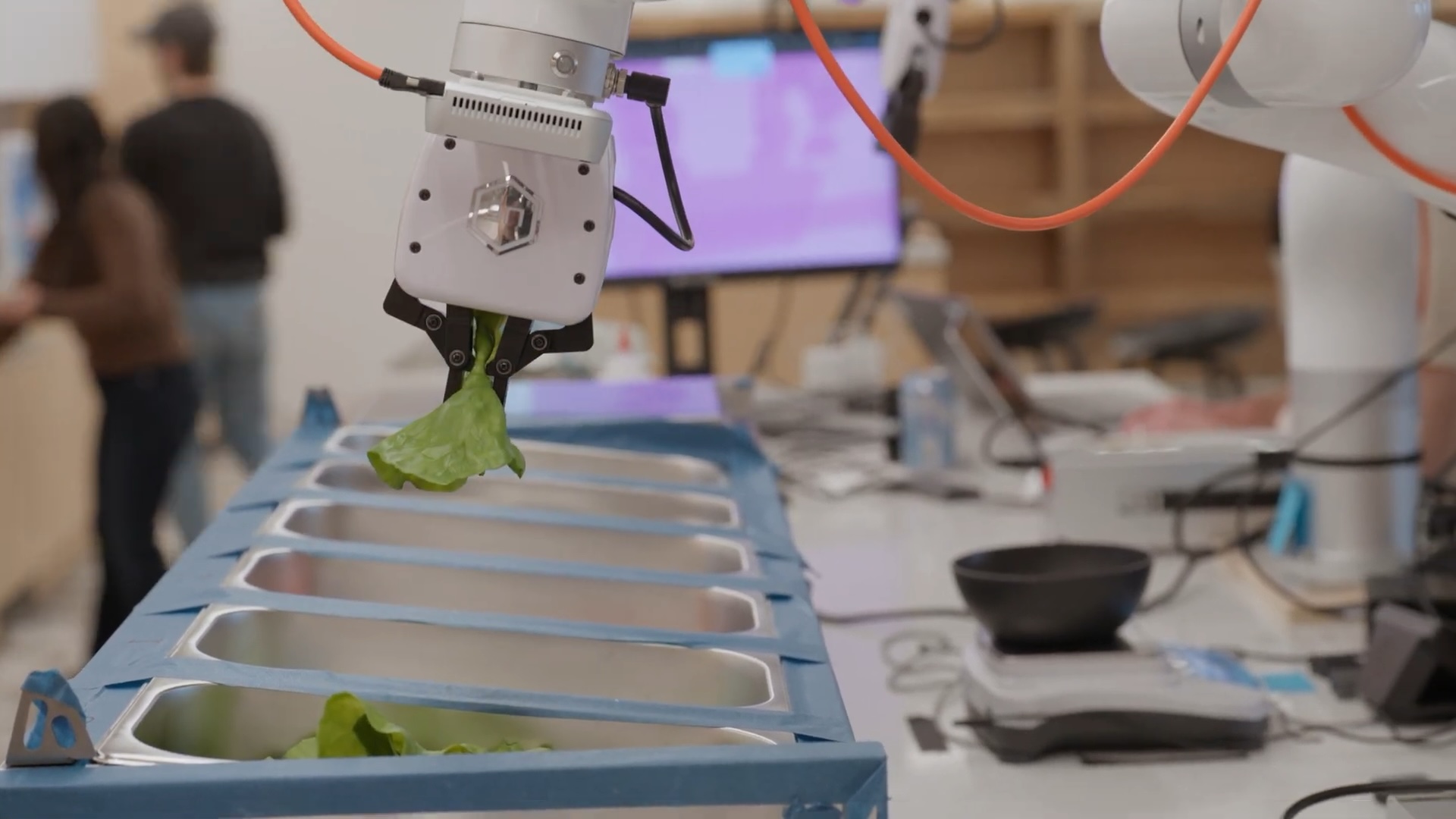
Giving a robot the same tools a human uses for food prep is harder than it looks, mostly because mapping human motion to a robotic frame of reference is a coordination headache. The team bypassed the usual manual math by configuring the robotic arm and grippers directly within Viam’s component registry, allowing them to focus on the application logic rather than the coordinate transforms.
By treating the gripper as a modular component rather than a custom-coded outlier, the team was able to hit a level of precision that felt human-centric. Their main takeaway? Don't over-engineer the hardware; sometimes the best tool for a robot is the one already designed for a human hand.
The rod hockey robot
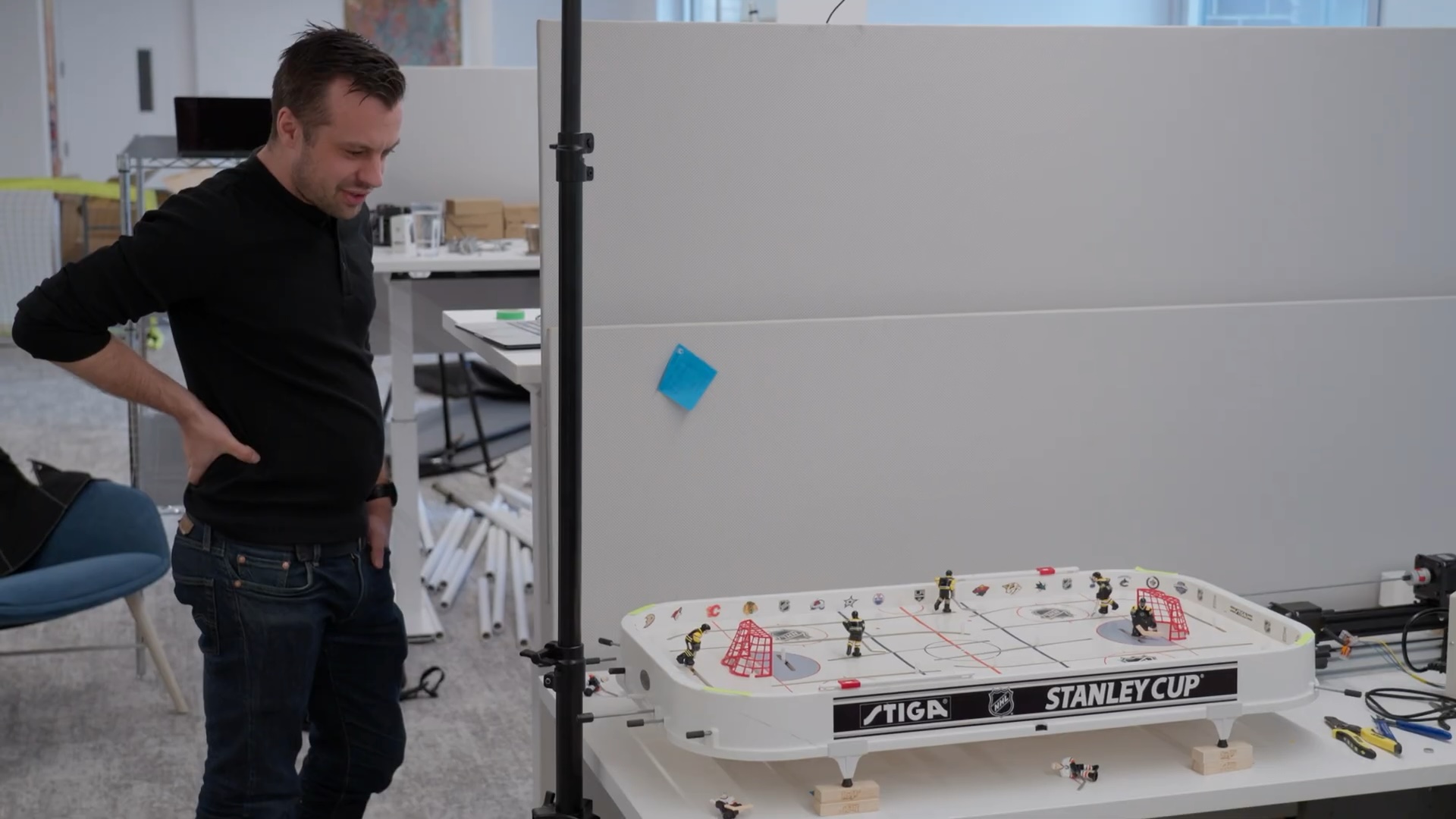
Led by Engineer Travis Gritter, this team set out to automate a classic rod hockey game (complete with Viam-sponsored Islanders players). The setup was a mechanical gauntlet: five player rigs, a goalie, and a network of stepper motors. The challenge wasn't just moving; it was reacting to a puck moving at high speed across a cluttered board. To solve this, the team used the color detector service to filter the visual noise and track the puck’s position in real-time.
Travis captured the breakthrough moment on day two: “Yesterday we didn't have any of the motors moving any of the players, but today we can now move the different players separately.” By the end of the sprint, they had a system using Pygame integrated with the Viam SDK to plan shots and defensive maneuvers based on that vision data.
The lab inventory tracker
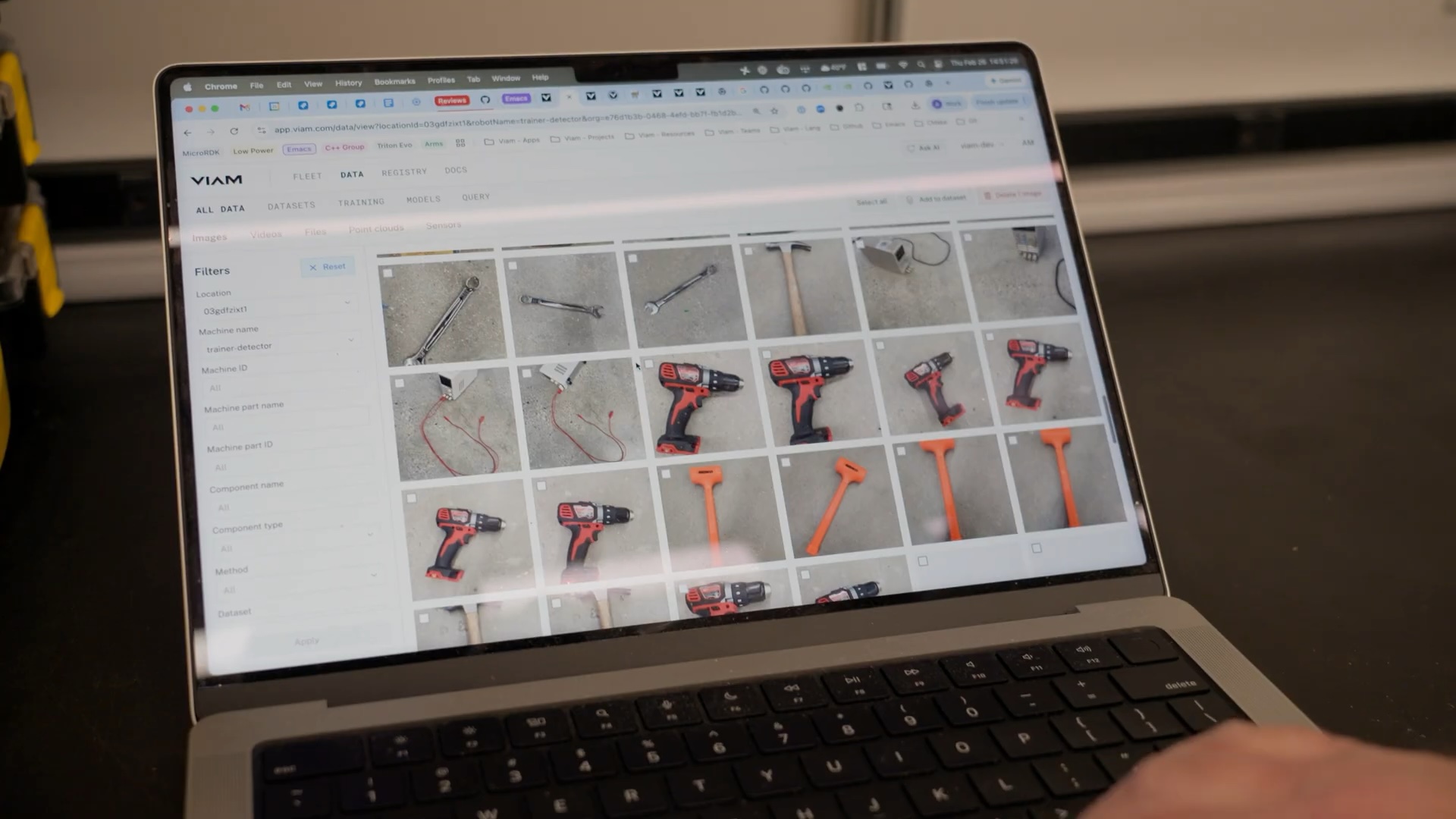
One team focused on the "day zero" problem: getting a robot to recognize objects it has never seen before. Using the Viam mobile app, they captured photos of specific tools around the lab to kickstart a data capture and ML training workflow. By offloading the model training to the cloud and deploying the results back to the edge in a single afternoon, they bypassed the traditional bottlenecks of manual data synchronization.
Staff Engineers Nicolas Menard and Andrew Morrow demonstrated the result by holding up a tool: "If I put the drill into the frame that the camera's looking at, you can see it saying 'cordless drill'... and that literally didn't exist 24 hours ago." It was a stark reminder that when the infrastructure for data ingestion is already built-in, the distance between "idea" and "inference" shrinks to almost nothing.
Using Viam When Your Deadline Is Four Hours Away
Robotics is notoriously difficult because it sits at the messy intersection of software, hardware, electronics, and physics. Viam addresses this by providing a unified abstraction layer for drivers and protocols, allowing developers to focus on high-level logic rather than low-level integration. As Senior Engineer Michael Lee noted, “Viam takes a lot of the math out of it; our motion planning does that for you.”
But it’s one thing to look at a dashboard and think a feature is "done," and another to use it while your hardware is vibrating and your deadline is four hours away. For software engineers like Cecily Munn, the platform significantly lowers the barrier to entry: “I have been really impressed with how quickly we’ve been able to just connect some things together and get it actually working.”
Building from the bottom up in three days is a pressure cooker, but it ensures Viam remains a platform built for developers, by developers. We came away with a shared understanding of what our users face every day, and the hands-on insights needed to build an even better software platform for the next generation of robotics.
But this isn't a one-off event. Our engineers don't just build Viam; they build on it. Through dedicated "Build on Viam" days, our team continues to build real robots with collaborators across the company. The builds get better over time, and as we continue to push the boundaries of our own tools, so does the platform.
Watch the full video below: