Key insights: Viam's robotics panel with UFactory and J.P. Morgan
Viam hosted industry leaders for a panel discussion on the evolving robotics landscape. The conversation explored how recent advances in accessible hardware, AI, and software platforms will transform the sector.
On September 16th, Viam hosted an evening exploring the rapidly changing robotics landscape alongside UFactory and J.P. Morgan. The event brought together startup founders, engineers, and tech investors for an interactive panel discussion, live robotic demonstrations, and networking focused on how affordable robotic hardware and flexible software platforms are enabling the next generation of robotic applications.
Our panel featured Edouard Servan-Schreiber (VP of Solution Engineering at Viam), Samuel Chau (General Manager US at UFactory), and Sharia Huda (VP of Emerging Tech and Startups at J.P. Morgan Commercial Investment Bank). The conversation revealed critical insights about the current state of robotics and what it takes for startups to succeed in this evolving space.
Engineers, founders, and investors gathered at the Viam HQ for a panel featuring industry leaders from Viam, UFactory and J.P. Morgan.
Here are some key takeaways from the discussion:
Building together beats building alone in robotics
One of the biggest challenges in robotics is that everyone is rebuilding the same foundational software from scratch. As Edouard explained during the panel, "Everyone seems to be trying to rebuild from scratch the same solutions in different contexts. Very few software engineers want to solve this problem, and everyone trying to rebuild the same thing feels like a waste."
This infrastructure gap creates unnecessary barriers for founders who should be focused on solving real-world problems, not wrestling with low-level hardware integration. The solution lies in a flexible platform that allows for:
Universal compatibility: Deploy code that works regardless of specific hardware
Modular component registry: Access pre-built modules for common robotics functions without custom development
Rapid prototyping: Test ideas quickly without rebuilding foundational technology
When startups can access robust, pre-built infrastructure like Viam, they can focus their energy on innovation and customer value rather than reinventing foundational technology.
Hardware accessibility is democratizing robotics for startups
The cost barrier that once kept robotics limited to large corporations is shrinking. Sam Chau highlighted this shift, noting that while traditional industrial arms cost $35,000-$40,000 plus service contracts, UFactory's xArm6 delivers comparable specs for $10,000.
This dramatic cost reduction is creating new opportunities for entrepreneurs:
Lower barriers to entry: Startups can afford to experiment and iterate
Reduced risk: Lower upfront investment makes failure less catastrophic
The democratization of hardware means robotics solutions are no longer limited to companies with massive R&D budgets.
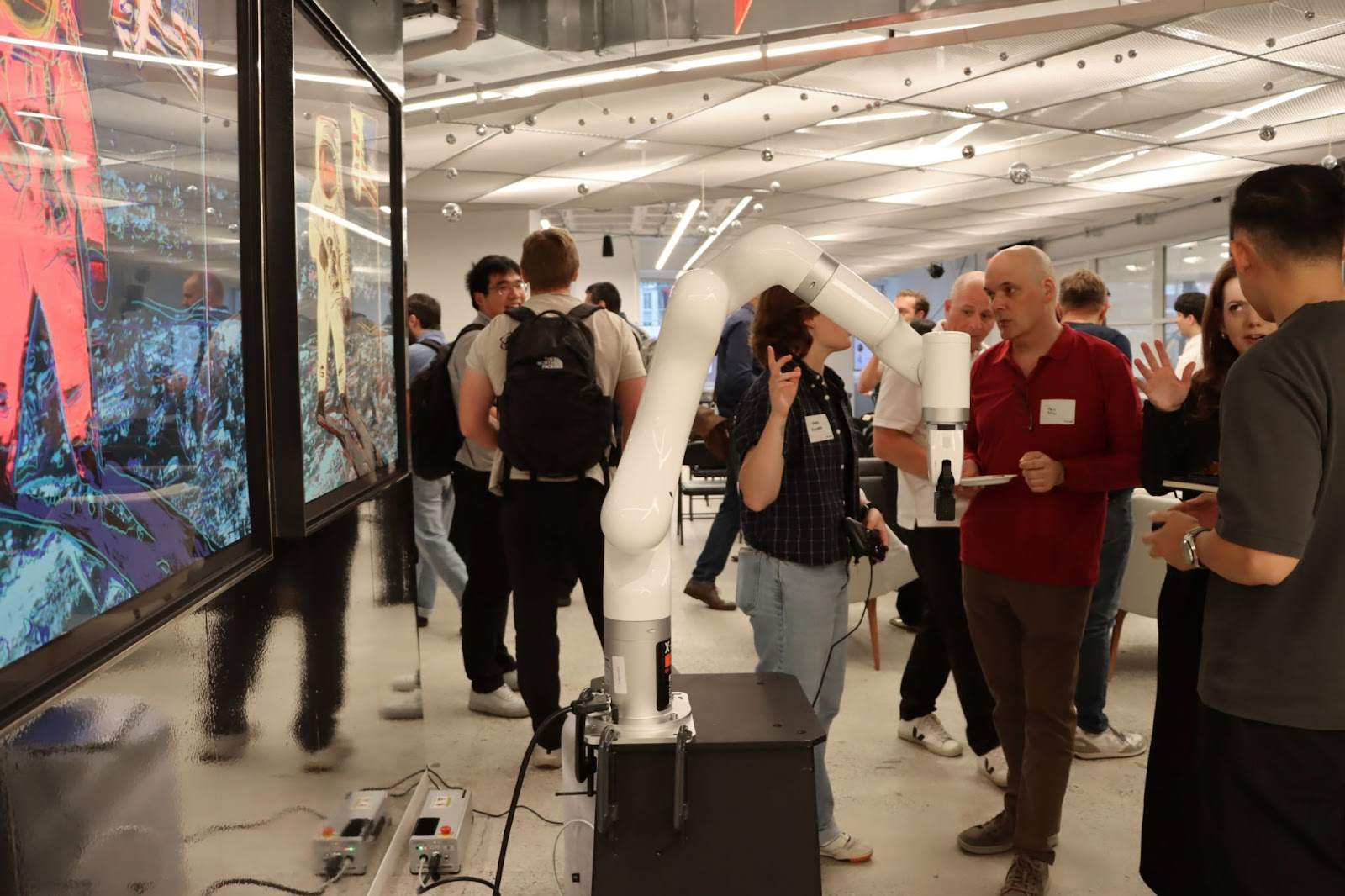
The UFactory team engaged the attendees with an interactive demo, allowing them to operate one of their arms.
Want to stay up to date on the latest happening at Viam? Sign up for our monthly newsletter.
AI is accelerating, making robotics more intuitive and practical
The integration of AI is transforming how robots interact with the physical world. Rather than requiring extensive programming for every scenario, AI enables robots to perceive, understand, and adapt to their environment.
Modern AI capabilities are making robotics more practical for real-world applications:
Intelligent perception: Ability to analyze scenes and respond to complex instructions
Adaptive behavior: Systems that adjust to changing conditions without reprogramming
This shift from rigid, pre-programmed systems to intelligent, adaptive robots opens up entirely new categories of applications that were previously impossible or prohibitively expensive to implement.
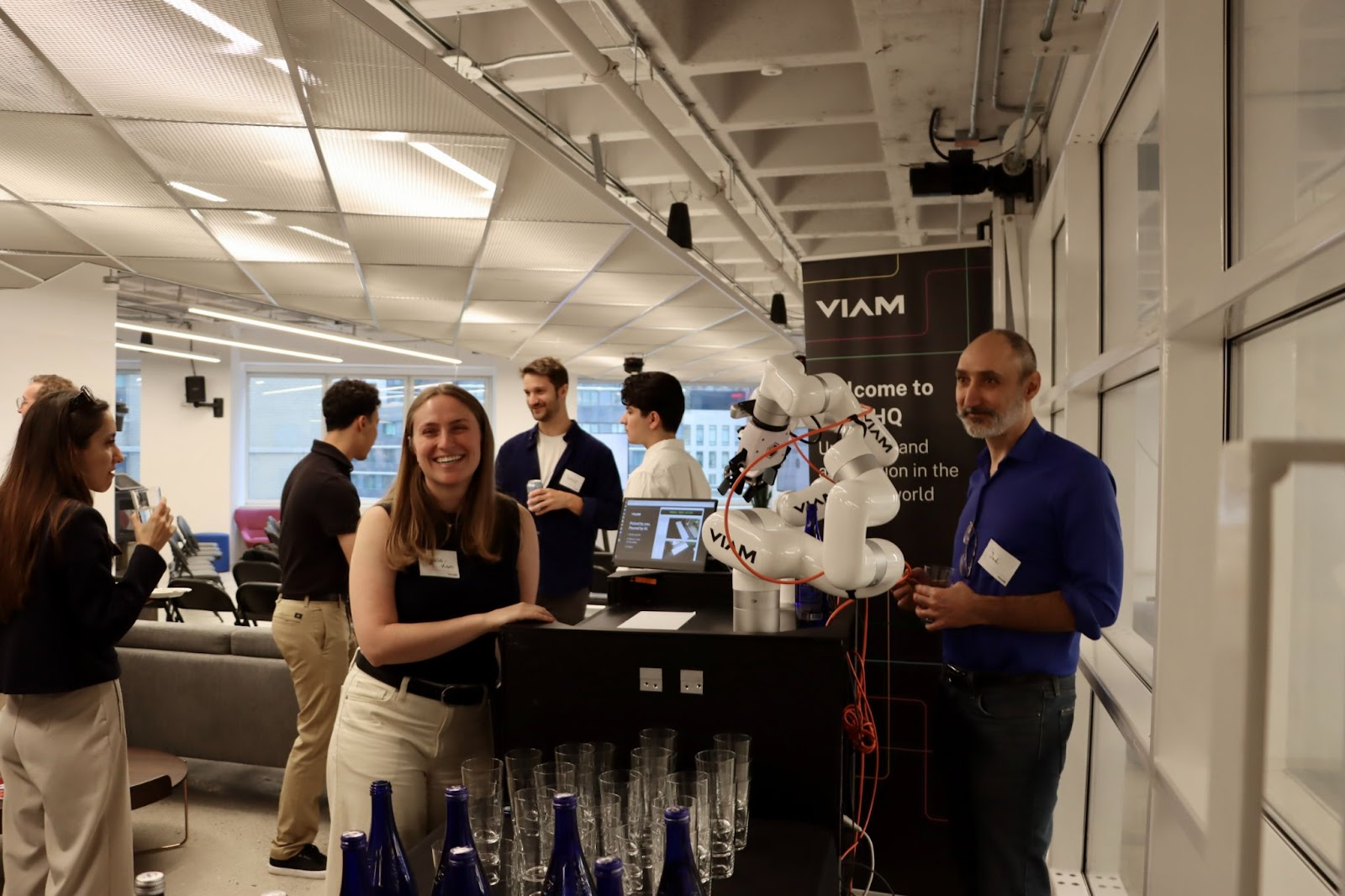
The Viam team demonstrated Viam's software platform working with UFactory arms with an engaging water-pouring robot.
Breakthrough innovation begins with solving practical problems
Many of today’s robotics startups that are really succeeding are solving straightforward, practical problems. Samuel shared examples of customer applications that deliver real business value.
The most successful robotics startups follow a clear pattern:
Start with contained, well-defined problems: Avoid trying to solve everything at once
Focus on immediate business value: Choose applications with clear ROI
Build on proven technology: Use reliable components rather than inventing from scratch
Plan for iteration: Design systems that can evolve as needs change
As Edouard noted, even revolutionary technologies like the telephone started with simple use cases, enabling communication between ground crews and workers on skyscrapers. The ambitious vision came later, built on a foundation of practical success.
Open platforms are accelerating growth in robotics
Attendees and panelists enjoyed a lively back and forth throughout the panel.
The robotics industry is moving toward an ecosystem approach where open platforms enable rapid innovation. Rather than building everything from scratch, successful companies are focusing on their core value proposition while leveraging shared infrastructure and components.
This platform approach accelerates innovation across the entire robotics ecosystem. When startups can access reliable, well-documented tools for hardware integration, computer vision, and AI deployment, they can focus their resources on solving customer problems rather than rebuilding foundational technology.
Find us at our next event
Error! No upcoming events found. Please check back later!

.png)