Marine manufacturers are facing a perfect storm: skilled finishers are retiring faster than new technicians can be trained, and the boats being built are more customized than ever. The solution isn't just more automation—it's bringing AI into the physical world to create robots that perceive, adapt, and collaborate well with humans.
Traditional robotic systems can't deliver this because they rely on CAD-based motion planning: rigid, pre-programmed paths from 3D digital blueprints. These systems don't reflect real-world conditions and must be reprogrammed with every design change. Manufacturers need intelligent, flexible systems that adapt to what's actually in front of them.
We sat down with Edouard Servan-Schreiber, VP of Solutions Engineering, and Jad Nehme, Senior Solutions Engineer Lead, to understand why Viam took a different approach—and why real-time 3D imaging is a game-changer for this application.
Marine manufacturing needs better automation
Q: What's driving the urgency for robotic sanding automation in marine manufacturing right now?
Edouard: The labor situation has reached a critical point. In many boat manufacturing regions, companies have tapped out the availability of skilled labor. You have good senior people who know what they're doing, but the technicians coming in don't have the experience. It’s also tough to retain technicians once they’re trained. So you end up paying for training, and then churn makes you lose your investment. That creates a consistency problem that compounds in tight labor markets.
Consistency is increasingly hard in this economy—and that's really what manufacturers need to solve for. It's not about speed necessarily; it's about delivering the same quality result every single time, regardless of who's on the floor that day.
Q: What makes robotic sanding particularly challenging in boat manufacturing environments?
Jad: Boat manufacturing is fundamentally different from high-volume, repeatable manufacturing environments. You're dealing with a heterogeneous mix of parts in the factory—different hull shapes, different sizes, constant customization requests.
Edouard: The recreational and leisure marine industries are fundamentally “low volume” by nature – they focus more on quality over quantity.
Jad: That’s right. Boat manufacturers need to be able to accommodate any request from a client at any point. A customer wants a different kind of anchor? That changes the geometry. Someone wants custom hardware? You're modifying the surface. And these aren't occasional exceptions—this is the norm.
Edouard: And then there's the materials themselves. Fiberglass and aluminum are imperfect materials. They don't behave predictably. Surface irregularities, minor manufacturing deviations—these are just part of working with composites. Even manufacturers making smaller boats deal with lots of adaptations and changes. You need flexibility in your automation approach, not rigidity.
“Consistency is increasingly hard in this economy—and that's really what manufacturers need to solve for.” – Edouard Servan-Schreiber, VP of Solutions Engineering
Why CAD-based automation systems fall short
Q: Given these challenges, you'd think automation would solve the problem. But traditional approaches bring their own limitations. What does a CAD-based approach look like?
Jad: In a traditional CAD-based approach, you start with a 3D file of the surface—that’s your CAD model. That model is used to generate pre-programmed paths that the robot will follow. The robot essentially traces those paths, assuming the physical part matches the digital model exactly.
Edouard: The approach makes sense when you need to operate on a large volume of the ‘same’ surface. Analyze once, operate many times. But it breaks down when you’re working with heterogeneous pieces.
Jad: That and CAD requires extensive setup and data preparation before the robot can even start. You need to import the CAD file, select the surfaces you want to work on, tune the paths—and all of this assumes you have an accurate, up-to-date CAD model in the first place.
Q: What happens when the real world doesn't match the CAD model?
Edouard: That's where things break down. The surface doesn't match at the level you need for precision sanding. Even if CAD could be perfect—which it can't—the materials move. Fiberglass has surface imperfections when it comes out of the mold. When you weld aluminum, it deforms slightly.
Jad: The CAD model is a reference, but it's not exact.
Edouard: And when you're doing custom work, you need to be extremely well organized. Any change you make needs to be documented and reflected in the CAD file. Otherwise, you're sending the robot to work on geometry that no longer exists. What marine manufacturers need instead is a system that can figure out how to sand any piece you need without lots of pre-programming. Like a human would.
“The CAD model is a reference, but it's not exact.” – Jad Nehme, Senior Solutions Engineer Lead
Send us your part — we’ll sand it and send it back.
A new approach: Viam’s real-time vision changes the game
Q: How does Viam's approach fundamentally differ from CAD-based systems?
Edouard: The key differentiation is that we use camera and LiDAR technology to compute motion plans in real-time. The robot perceives the part in front of it, understands what it's looking at, and generates the appropriate motion plan.
Different parts get different plans. There's no manual programming step where you're telling the robot, "This is a hull section, sand it this way." The system figures that out on its own.
Jad: Real-time imaging is about understanding the actual surface in front of you, not what the CAD drawing says should be there.
Q: Walk us through the technical process. What actually happens when your robot approaches a new surface it's never seen before?
Edouard: In simple terms: the robot looks at the part, figures out what needs to be sanded, plans the best way to do it, then executes. Here's how that works in practice:
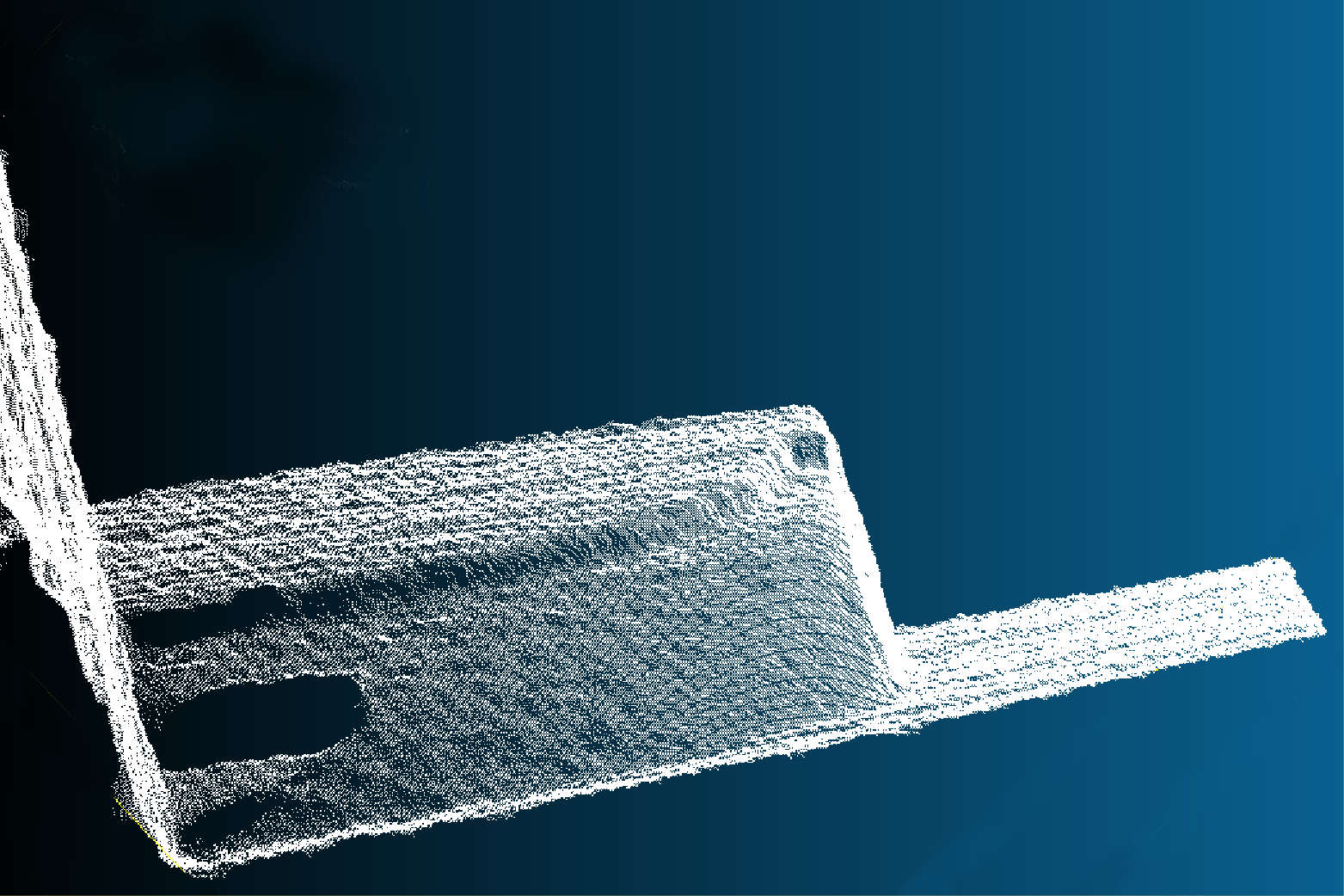
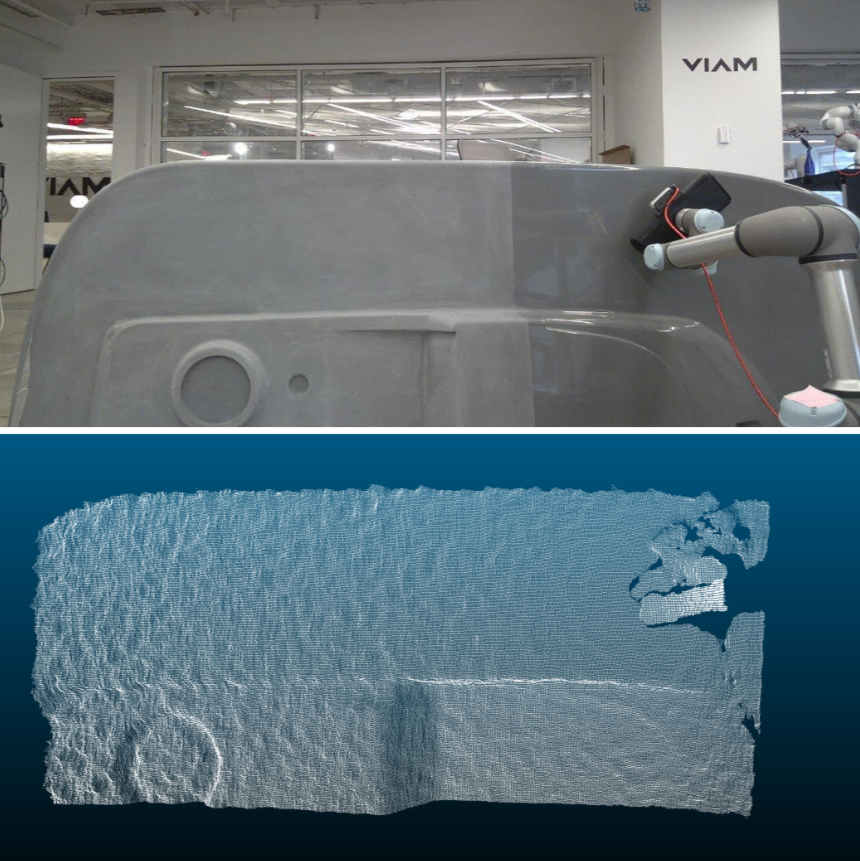
Scanning: We use cameras with LiDAR to capture images and point clouds of the surface. The cameras locate the blue dye on the part, while LiDAR provides details of the surface.
Calibrating: The robot understands where it is relative to the boat component so that subsequent steps can be precise at the sub-millimeter level.
Surface mapping: The robot takes several images until we've captured the whole surface—this typically takes a couple of minutes. Then, it splices the images together (which is standard CV assembling) so the robot can see the full area it's going to work on.
Analyzing the surface: This is where it gets specific to our problem. The system analyzes: Where is the surface continuous? Where is it flat? Where's the blue dye? Where are the ridges and corners? It's understanding the surface for our particular use case.
AI-powered decisioning: Here's where the robot applies the provided business logic to determine what parts of the surface should be sanded: where there's blue dye and where the surface is continuous.
Motion planning: We divide the surface into reasonable sections so we can plan motion for each section. This is actually the longest part of the process—generating the optimal motion plan while respecting the stated business logic, safety parameters, etc.
Executing: Finally, the robot executes using the parameters the client specifies as appropriate: the stroke pattern, the angle, the level of pressure, the stroke length.
The same fiberglass component, two perspectives: (Top) Standard camera view. (Bottom) 3D point cloud data the robot uses to map the surface and generate motion plans.
Q: What makes real-time 3D imaging possible? What's happening under the hood?
Jad: We're combining multiple sensor types and analysis layers. Cameras give us detailed surface imaging. LiDAR generates point clouds for precise spatial mapping down to the millimeter. Then we use computer vision for image assembly—that part uses fairly standard techniques.
We've built algorithms specifically for understanding surfaces in the context of sanding, like identifying continuous areas or detecting surface characteristics. And the power of the Viam platform is that we can apply that imaging to the physical world for a variety of tasks: sanding, contouring, or coating. It's about addressing a specific manufacturing problem, not just creating a generic 3D scan.
Aspect
CAD-Based Systems
Viam's Real-Time Imaging Approach
Setup
Requires CAD file creation, import, surface selection, and path tuning
Requires only sensor calibration to start; no CAD for path programming
Flexibility
Works only with fixed, known parts
Adapts to variable parts and orientations
Work Scalability
Could work for repeatable, high-volume manufacturing
Ideal for mixed production, custom pieces, and composites (e.g., fiberglass)
Programming Overhead
High: Each new part requires a new CAD file
Low: Sanding station takes 3D images and adapts
Above: Side-by-side comparison of CAD-based automation versus Viam’s approach to robotic sanding based on real-time imaging.
From technology to results: What this means for your factory
Q: At this year’s International BoatBuilders' Exhibition and Conference (IBEX), you mentioned getting lots of questions about hardware—arm size, whether the system is fixed or mobile, whether it can handle whole hulls. How do you address the "operational problem" manufacturers are really worried about?
Edouard: What we learned at the show is that people instinctively focus on hardware first. They'd look at the robot arm in our demo booth and say, "But this arm isn’t right for my production line—how can you use it to sand a whole boat?" And our answer is: we can use any arm. Due to our underlying software, the system is adaptable.
There are two separate things here: form-factor and the data and programming process. Yes, hardware matters—Can you reach the surfaces you need? Is it the right size for your factory? Can you move it around or is it fixed?—but the really interesting conversation happens when we shift from hardware to intelligence.
The data and programming process is where the operational opportunity really lives. Viam's AI intelligence layer handles variability automatically. Whether you're working on whole hulls, hardtops, small boats, large boats—the system adapts. That's what we mean when we talk about separating the intelligence from the hardware constraints.
“The data and programming process is where the operational opportunity really lives. Viam’s AI intelligence layer handles variability automatically…you eliminate manual reprogramming for each new part or geometry change.” – Edouard Servan-Schreiber, VP of Solutions Engineering
Q: Let's talk about the bottom line. What tangible benefits would a boat builder see from using Viam's sanding solution with this kind of intelligence?
Edouard: The biggest benefit is that with Viam, you eliminate manual reprogramming for each new part or geometry change. When a customization request comes in, the system handles it. You're not updating CAD files and regenerating paths to maintain perfect alignment between your CAD library and your physical parts.
Jad: And you also maintain consistency across a heterogeneous factory environment. Whether you're building 30-foot boats or 80-foot yachts, whether it's hull number 1 or number 1,000, you get the same quality result.
Edouard: You can also apply this same intelligence to multiple surface finishing operations. If you can understand the surface for sanding today, then you can use that same technology for other stages like gelcoat application, polishing, and finishing. The ability to perceive the part in real-time and make a motion plan based on that perception is huge.
Q: You both attended IBEX 2025 in October. How did boat manufacturers react when they saw Viam's sanding demonstration?
Jad: What was interesting is that most of these manufacturers haven't necessarily tried an automation solution before, yet they're clearly aware it's needed for the sake of consistency in sanding output. The labor situation is forcing their hand.
Edouard: Right. The questions were very practical: "How would it work for us specifically?" "Can you really do a whole boat, like hardtops with large continuous areas?" "Is the system fixed or do you move it around?" "Can you handle this particular small shape or that geometry?"
Those conversations were really valuable because they showed us manufacturers are moving past "should we automate?" to "how do we make automation work in our specific factory?" That's exactly the conversation the industry needs to be having.
Achieving consistency and quality through automation
Real-time 3D vision eliminates the rigid constraints of CAD-based programming, making robotic sanding and broader surface finishing automation viable for the variability and customization demands of marine manufacturing.
For an industry facing critical labor shortages, this represents more than operational improvement, it's removing a bottleneck to growth. Viam's physical AI approach—bringing intelligence into the physical world—delivers the adaptability manufacturers need for customizable, high-variability production. The promise of robotics isn't perfection, but something more valuable: measurable, consistent performance for high quality finishes.
Want to see Viam’s robotic sanding solution in action? Send us your part.
Find us at our next event
Error! No upcoming events found. Please check back later!