How Pull To Refresh builds environmental solutions with Viam
Pull To Refresh is a startup building solutions to waste management challenges in the Philippines; learn why their early choice of tech stack has been pivotal to their progress so far.
When the Pull To Refresh team first began building teleoperated robots to manage invasive sargassum seaweed, they never imagined their work would eventually take them to garbage processing facilities in the Philippines. The pivot to waste management happened when they realized their sensor monitoring and cloud connectivity solutions could tackle a much larger environmental challenge.
Pull To Refresh, an early-stage startup that recently completed the TechStars accelerator program, embodies the pragmatic innovation we're excited about in the developer community. Chris Paliqaw, the company's CTO and co-founder, brings software development experience and robotics experience.
When Chris discovered Viam, he found something traditional frameworks couldn't offer: a faster path from prototype to production-ready systems. He wanted a platform that would enable quick iteration on early prototypes, but that would also support their growth as they found market traction and moved towards production deployment.
The beginning: prototyping marine robotics with cloud-first architecture
The team's original marine robotics application tackled a real environmental challenge. Sargassum seaweed has overwhelmed Caribbean and Gulf coastlines for over a decade, creating massive piles that rot on beaches and disrupt both tourism and marine ecosystems. Pull To Refresh developed a teleoperated robot on Viam that could push the invasive seaweed into nets to sink it, reducing the carbon impact.
"You can do a lot with available components and cloud functionality, even before writing your own components," Chris notes about their early Viam implementation. Viam's cloud connectivity made it easy to set up their first trial runs, especially when working with unreliable network connections at remote beach locations. Within 2 weeks, they had a cloud-connected robot on the water. That wouldn't have been possible without Viam.
But the seaweed business revealed a fundamental challenge: building a sustainable company around unpredictable, seasonal feedstock proved difficult. And government restrictions meant they could only remove seaweed when it became severely problematic, creating an unreliable business model despite the clear environmental need. This led the team to explore other applications for the technology.
The pivot to waste management
Excess waste is a global challenge, and the Philippines presents an ideal market because many of the country’s island communities lack landfill space and must pay premium rates for garbage disposal. This environment creates a significant need for more cost-effective solutions.
This subsequent pivot to waste management wasn't just a business decision—it was an engineering insight. The sensor monitoring, cloud connectivity, and data analysis systems they'd built for marine robotics translated directly to a larger environmental challenge: helping island communities manage waste responsibly while generating carbon credits.
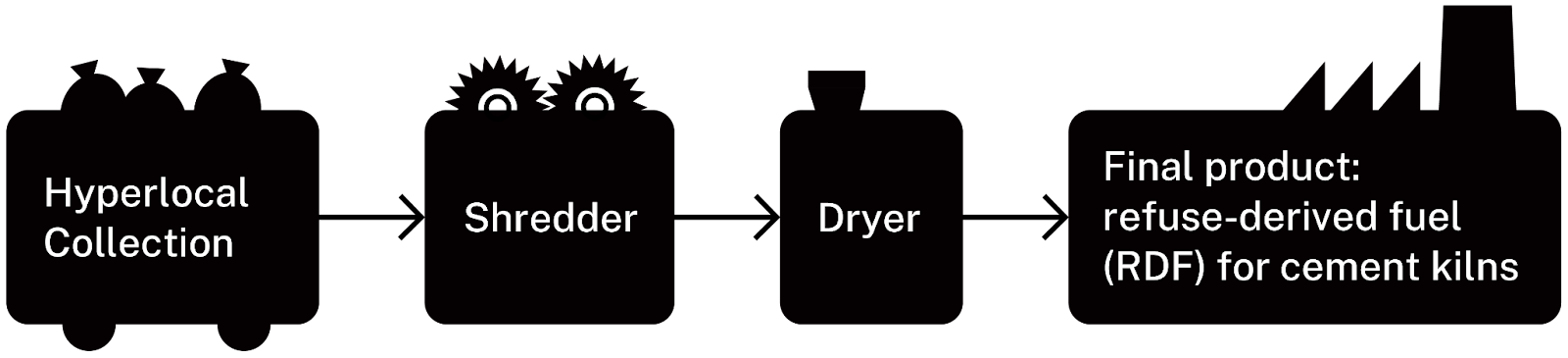
Using the same sensor integration methods developed for their marine robotics, Pull To Refresh built custom Viam components that seamlessly connect a network of sensors tracking the waste management process, enabling server-side analytics and anomaly detection. The result is a new approach to waste management that requires minimal supervision while maintaining high product integrity through automated quality control. Pull To Refresh processes the waste into an energy product that serves as a coal alternative for cement factories.
The waste management lifecycle powered by Pull To Refresh with Viam
The challenge lies in precisely measuring moisture content and energy density on a per-bag basis to ensure product quality—as well as knowing the nature-based carbon content and the emissions created at every stage. You can learn more about their approach in the video below.
Pull To Refresh’s financially and environmentally efficient solution is designed to solve the immediate waste overflow challenges while aligning with national governments’ climate initiatives.
Viam supports future scale across distributed locations with peer-to-peer communication
What makes Pull to Refresh's implementation compelling isn't just the environmental impact—it's also how they've structured their technology stack to scale across distributed locations. Chris's experience with traditional pub-sub architectures led him to appreciate Viam's point-to-point communication model.
In traditional approaches, "All the components are spraying messages that everyone can choose to subscribe to," he explains, contrasting it with Viam's more intuitive WebRTC-enabled peer-to-peer connections. For a distributed sensor network designed to scale across multiple island processing facilities, this architectural choice becomes crucial.
Rather than managing message noise across dozens of sensors, each component communicates directly with what it needs to reach using gRPC over WebRTC.
By designing a facility that is always on and always connected to the internet, Pull To Refresh's sensor integration serves a different purpose than typical factory automation. While most factory sensors drive operational processes, Pull To Refresh’s approach focuses on server-side anomaly detection, algorithmic quality control, carbon accounting dashboards, chain of custody tracking, third-party auditing tools, and contamination records.
Each Viam component stores sensor data permanently, enabling the team to build cloud services off the API that deliver the quality assurance and accounting their municipalities, cement factories, and carbon removal customers demand.
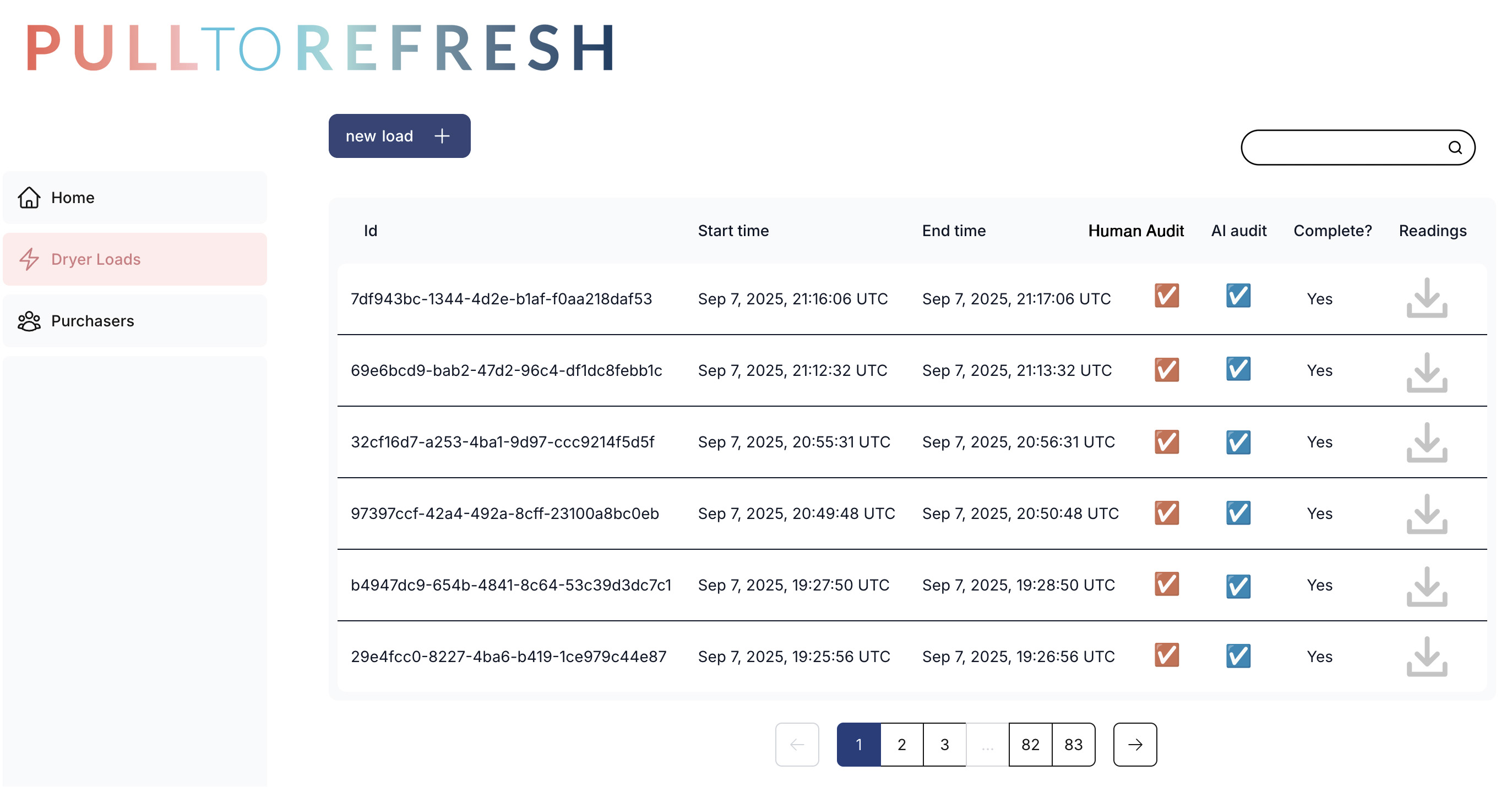
The team uses Raspberry Pi devices to power and run their sensor arrays, streaming data for server-side processing. Their dryer control system uses weight and humidity sensors to determine when to stop the drying process and to calculate moisture levels, which will have a huge influence on how much coal they can replace at a cement factory's cement kiln.
Sensor data measuring char loads
As of Fall 2025, Pull To Refresh is continuing to build toward production deployment, refining custom Go components for control systems and integrating Viam APIs for custom model deployment.
Production-ready environmental technology
Moving from prototype to production means solving problems that don't appear in development environments. Pull To Refresh's sensor network needs to detect equipment malfunctions, prevent fraud, and maintain the data quality standards required for carbon credit auditing. Accordingly, Pull To Refresh is training transformer models for anomaly detection on the kinds of patterns that only emerge from complex, real-world data.
Regulatory requirements add another layer of complexity. Annual auditor visits mean maintaining clear accounting for carbon credits, while real-time monitoring will be key to enabling customers to trust every step of the process and to manage multiple facilities with a singular software stack.
"Once we get into production, people need clear accounting," Chris notes, emphasizing how sensor-enabled quality control becomes both a technical and business advantage.
Viam's modularity proves essential here. Custom workflows can be implemented as private modules, while the underlying platform handles cloud connectivity and data management. The team also uses Viam's dashboard for remote diagnostics, enabling quick troubleshooting and system monitoring when hardware issues arise.
Modularity matters because getting a sensor reading into a database is only the first step. “The real power is unlocked when we train models to instruct the factory on what to do, instead of relying on clunky timers,” says CEO and co-founder Arin Crumley.
This design approach will allow Pull To Refresh to improve efficiency, creating a network effect in which facilities will be able to pool data to create larger training sets that benefit each facility when updates are pushed.
Pull To Refresh’s journey from marine robotics to waste management shows how the right platform choices accelerate development while opening unexpected opportunities.
Want to share your own story of building with Viam? We'd love to hear from you. Connect with us on the Viam Discord and let us know in the #built-on-viam channel, where you can follow along with the Pull To Refresh journey and be inspired by other projects.
Find us at our next event
Error! No upcoming events found. Please check back later!


.jpg)