.png)
.png)


The age of physical AI is here.
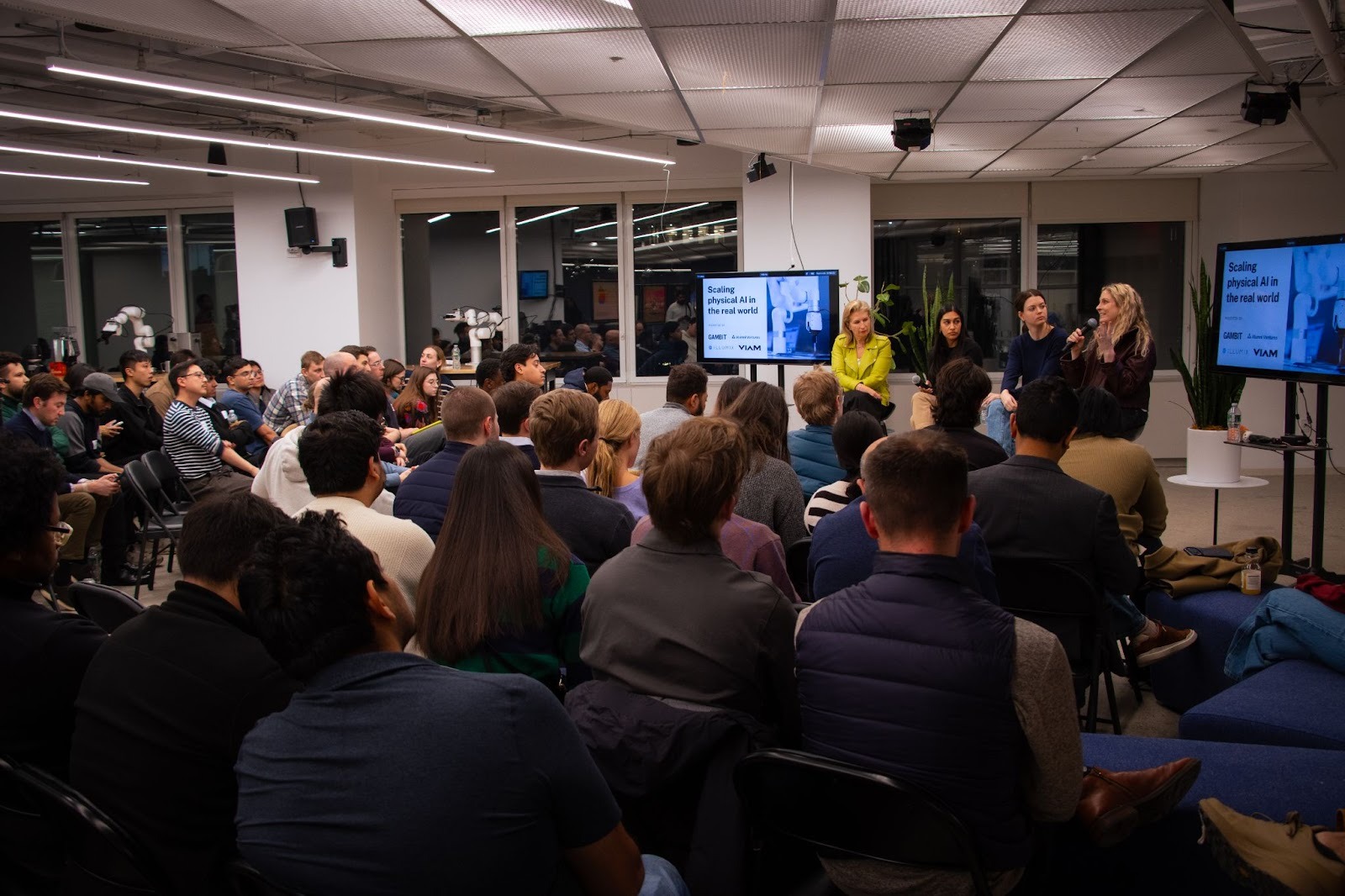
On February 19, we brought together leaders at the forefront of physical AI for a panel discussion at the Viam HQ. Simone Kalmakis, VP of Engineering at Viam, joined Nicole Maffeo, Cofounder of Gambit Robotics, and Kirin Sinha, Founder and CEO of Illumix, for a conversation moderated by Laura Rippy, Managing Partner at Alumni Ventures. The discussion explored the realities of building and deploying intelligent systems in production environments, from the importance of rapid iteration to the value of human-machine collaboration. Here are some key takeaways from their discussion.
Iteration speed is everything
Unlike software, physical AI systems require constant experimentation across hardware, sensors, and algorithms. The ability to iterate quickly separates successful deployments from those that stall in development.
Simone emphasized how bringing software engineering practices into the hardware world accelerates this process. "If there's one thing I've learned since transitioning into the robotics space, it's that iteration is so key and you don't know what will work ahead of time," she said. "So much of the speed that you get when you're developing a robotic solution comes from your ability to quickly iterate."
Nicole reinforced this from her experience building Gambit on Viam. "When [the prototype] is not working, because we're still building it and often it does not work, Viam allows you to basically double click in on where in the pipeline the thing is broken," she explained. "You're able to debug quickly, but more importantly: systematically and reliably."
Human with machine, not human versus machine
A recurring theme throughout the evening was designing physical AI systems that augment human capabilities rather than attempting full automation. This philosophy reflects both the current limitations of the technology and a more pragmatic path to value creation.
Nicole articulated this clearly: "It's not human versus machine, it's human with machine. What I'm really excited for is how we can use intelligent devices to make the day-to-day easier and better."
This collaborative model reflects one of the fundamental challenges in physical AI: real-world environments are messy and unpredictable. By keeping humans in the loop, systems can leverage AI for tasks it excels at, such as pattern recognition, continuous monitoring, and data processing, while relying on human judgment for complex decision-making.
From algorithms to real-world deployment
The conversation also surfaced a critical gap between AI capabilities and production readiness. While software capabilities have advanced dramatically, hardware constraints and real-world conditions continue to present significant challenges.
Kirin predicted that we'll see continued software advances followed by a period where the industry waits for hardware to catch up. "A lot of the people we talk to are no longer blocked by the software limitations so much as 'I need a thumb to work, I need my hand to really work,'" she said, referencing the mechanical challenges that still limit physical AI applications. This hardware reality shapes deployment strategies.
Beyond mechanical constraints, deployment in real-world environments introduces other infrastructure challenges. Edge computing addresses several of these at once by reducing latency for real-time applications, lowering connectivity costs, and addressing privacy concerns. For systems operating in environments with intermittent internet access, local processing isn't just an optimization—it's a requirement.
Beyond the hype: Specialized applications over general-purpose robots
While humanoid robots capture headlines and imagination, the panel offered a more measured perspective on timelines and opportunities, offering the perspective that humanoid robots may not be deployed at scale in the immediate future.
This doesn't mean physical AI lacks near-term opportunities. In fact, the opposite is true: specialized, purpose-built intelligent systems are already delivering value across industries. The key is matching the technology to well-defined problems rather than pursuing general-purpose solutions to replicate human versatility.
Building on solid foundations
The evening reinforced a simple truth: successful physical AI deployment isn't just about the AI. It requires infrastructure that bridges software and hardware, enables fast experimentation, and gives teams real visibility into complex systems. The teams making progress aren't chasing general-purpose solutions — they're iterating quickly, keeping humans in the loop, and building for reliability outside the lab.
Build your own intelligent system or learn more about how the Viam platform supports robotic builds from prototype to production.